

“Stretch your hamstrings.” Most of us have heard it, and most of us don’t do it. Here’s why it’s worth the few minutes.
When I assess people with lower back niggles or a slumped posture, tight hamstrings are often part of the picture. They’re rarely the whole story, but they’re an easy thing to work on at home.
Why do tight hamstrings matter?
- Your lower back. Your hamstrings attach to your pelvis. When they’re tight, your pelvis moves less, so your lower back often ends up doing extra work when you bend and lift. Keeping your hamstrings both flexible and strong takes some of that load off.
- Your posture. Tight hamstrings tug the pelvis into a tucked-under position and flatten the natural curve of your lower back. That can make it harder to sit tall and stand straight.
- How you move. Flexible muscles and mobile joints simply make everyday movement, and sport, feel easier.
My 4 favourite hamstring stretches
Ease into each one. You should feel a stretch, never sharp or nerve-like pain. Download the printable hamstring stretches guide (PDF) to keep on the fridge.
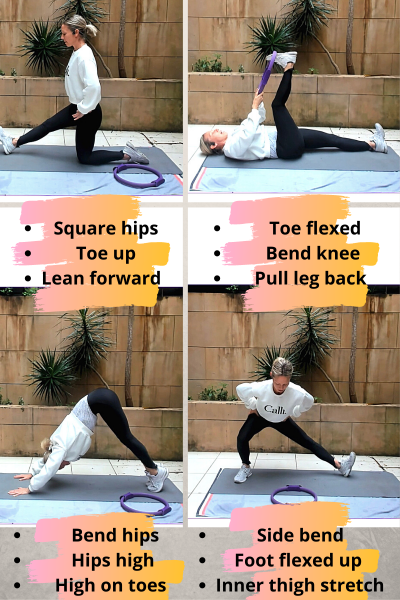
1. Kneeling hamstring stretch (pelvis focus)
- Kneel tall with your spine in neutral.
- Place your right leg straight out in front, heel on the ground and toes pointing up.
- Hands on hips, keeping both sides of your pelvis level.
- Gently hinge forward from the hips. Keep your focus on your pelvis and alignment, which might mean only a small lean.
- Hold 10–30 seconds, 2–4 times each leg.
2. Lying hamstring stretch with a strap
- Lie on your back with both legs straight.
- Bend your right knee and loop a strap (or towel) around the ball of your right foot, holding it in both hands.
- Keep your left leg long and firm on the floor with the foot flexed.
- Slowly straighten your right leg towards the ceiling, keeping a soft bend in the knee.
- Gently draw the strap in until you feel light tension in the back of the thigh.
- Hold 10–30 seconds, 2–4 times each leg.
3. Downward dog
- Start on hands and knees. Spread your fingers wide and press evenly through your palms.
- Breathe out, tuck your toes and lift your knees, sending your hips up towards the ceiling.
- Gently straighten your legs without locking your knees, so your body makes an upside-down “V”.
- Pedal your feet to mobilise.
- Take 6 slow breaths in and out.
4. Side lunge stretch
- Stand with your feet wide.
- Bend your left knee into a half-squat. Keep your right leg straight, pressing into the heel with the toes lifted.
- Send your hips back while keeping your spine long.
- Use your hands on the floor for balance, or stretch your arms out wide.
- Hold for a few breaths, then shift across to the other side.
Stretching not enough?
If your hamstrings feel tight no matter how much you stretch, or you get pain down the back of your leg, there may be more going on, such as a nerve, your lower back or a hamstring that needs strengthening rather than stretching. Book an appointment and I’ll work out what’s driving it and build you a plan.